
Changing the Narrative: Why Kids Really Enter Foster Care
It is easy to look at the foster care system through a simple lens: there are good parents and there are bad parents. We imagine children being rescued from malicious villains and assume that violent abuse is the primary reason families enter the system.
But anyone who has spent time with families in crisis knows a far more humbling truth: most parents love their children. The reality of foster care is rarely a story of pure malice. More often, it is a story of poverty, untreated trauma, addiction, or life circumstances that become more than a family can carry alone.
Instead of asking, "What's wrong with them?" we're invited to ask, "How can we help?" That simple shift moves us from judgment to compassion—and often becomes the first step toward hope for a child and their family.
But anyone who has spent time with families in crisis knows a far more humbling truth: most parents love their children. The reality of foster care is rarely a story of pure malice. More often, it is a story of poverty, untreated trauma, addiction, or life circumstances that become more than a family can carry alone.
Instead of asking, "What's wrong with them?" we're invited to ask, "How can we help?" That simple shift moves us from judgment to compassion—and often becomes the first step toward hope for a child and their family.
What the Data Tells Us
The national data from the Adoption and Foster Care Analysis and Reporting System (AFCARS) paints a very different picture than many people assume. While abuse certainly occurs and must always be taken seriously, the majority of children enter foster care because families are facing overwhelming crises.
In fact, roughly 85% of foster care entries do not involve violent abuse or intentional physical or sexual harm.
A Quick Note on the Numbers: You’ll notice the percentages below add up to more than 100%. This is because child welfare agencies record every contributing factor in a case. A single family may be struggling with housing instability, a sudden job loss, and neglect at the same time, so multiple reasons are documented for one child's placement
In fact, roughly 85% of foster care entries do not involve violent abuse or intentional physical or sexual harm.
A Quick Note on the Numbers: You’ll notice the percentages below add up to more than 100%. This is because child welfare agencies record every contributing factor in a case. A single family may be struggling with housing instability, a sudden job loss, and neglect at the same time, so multiple reasons are documented for one child's placement
The Top 10 Reasons Children Enter Foster Care
1. Neglect (Approx. 60+%)
By far the leading reason. Neglect is rarely a choice; it is almost always closely intertwined with poverty and a caregiver's inability to consistently provide food, clothing, housing, supervision, or other basic necessities.
2. Parental Substance Abuse (Approx. 34%)
Addiction is a devastating, isolating disease. When substances take hold, they impair a parent's ability to maintain a safe environment. Many parents battling addiction desperately love their children while fighting an illness that has taken control.
3. Physical Abuse (Approx. 12%)
Involves intentional, non-accidental injury. It is deeply serious and deserves immediate intervention, yet it represents a much smaller percentage of entries than the public often realizes
4. Domestic Violence (Approx. 10%)
Children are often removed because ongoing violence between adults creates an environment filled with fear, instability, and emotional trauma—even when the child is not the direct target.
5. Inadequate Housing (Approx. 9%)
Dangerous or completely unstable living conditions (such as chronic homelessness). While agencies attempt to provide housing assistance first, removal happens when the physical environment poses an immediate safety risk.
6. Parental Incarceration (Approx. 6%)
When a primary caregiver is arrested and no safe, approved family member or close friend is immediately available to step in and provide custody.
7. Abandonment (Approx. 4%)
Cases where children are left without care, including desperate "safe haven" relinquishments of newborns at hospitals or fire stations by parents who feel completely out of options.
8. Child Behavior Challenges (Approx. 4%)
When a child has profound mental health needs or severe developmental disabilities, and a family lacks the immense financial resources, medical support, or respite care to keep the home safe.
9. Sexual Abuse (Approx. 4%)
While highly publicized and demanding swift protection, sexual exploitation statistically accounts for a very small percentage of total entries compared to the weight of neglect and substance abuse.
10. Parental Illness or Death (Approx. 2%)
Pure tragedy. When a sole caregiver dies or becomes critically ill and no approved relative can immediately step in, temporary foster care becomes the safest fallback option.
By far the leading reason. Neglect is rarely a choice; it is almost always closely intertwined with poverty and a caregiver's inability to consistently provide food, clothing, housing, supervision, or other basic necessities.
2. Parental Substance Abuse (Approx. 34%)
Addiction is a devastating, isolating disease. When substances take hold, they impair a parent's ability to maintain a safe environment. Many parents battling addiction desperately love their children while fighting an illness that has taken control.
3. Physical Abuse (Approx. 12%)
Involves intentional, non-accidental injury. It is deeply serious and deserves immediate intervention, yet it represents a much smaller percentage of entries than the public often realizes
4. Domestic Violence (Approx. 10%)
Children are often removed because ongoing violence between adults creates an environment filled with fear, instability, and emotional trauma—even when the child is not the direct target.
5. Inadequate Housing (Approx. 9%)
Dangerous or completely unstable living conditions (such as chronic homelessness). While agencies attempt to provide housing assistance first, removal happens when the physical environment poses an immediate safety risk.
6. Parental Incarceration (Approx. 6%)
When a primary caregiver is arrested and no safe, approved family member or close friend is immediately available to step in and provide custody.
7. Abandonment (Approx. 4%)
Cases where children are left without care, including desperate "safe haven" relinquishments of newborns at hospitals or fire stations by parents who feel completely out of options.
8. Child Behavior Challenges (Approx. 4%)
When a child has profound mental health needs or severe developmental disabilities, and a family lacks the immense financial resources, medical support, or respite care to keep the home safe.
9. Sexual Abuse (Approx. 4%)
While highly publicized and demanding swift protection, sexual exploitation statistically accounts for a very small percentage of total entries compared to the weight of neglect and substance abuse.
10. Parental Illness or Death (Approx. 2%)
Pure tragedy. When a sole caregiver dies or becomes critically ill and no approved relative can immediately step in, temporary foster care becomes the safest fallback option.
Every Child Has a Story. Every Family Has One Too.
Looking at this list, one truth becomes impossible to ignore: many of these circumstances are only one crisis away for countless families.
If life had unfolded just a little differently, any one of us could find ourselves facing challenges we never imagined. Foster care reminds us not only of a child's vulnerability, but of our own.
- A lost job.
- An untreated addiction.
- A medical emergency.
- A mental health crisis.
- The absence of a support system.
If life had unfolded just a little differently, any one of us could find ourselves facing challenges we never imagined. Foster care reminds us not only of a child's vulnerability, but of our own.
Where the Church Comes In
This is where God’s people have a unique opportunity. We serve a God who restores broken people and broken families, and we are called to see individuals not as labels or statistics, but as people created in His image.
Every child entering foster care has a story. Every biological parent fighting to reunify has a story. Every foster family opening their home has a story.
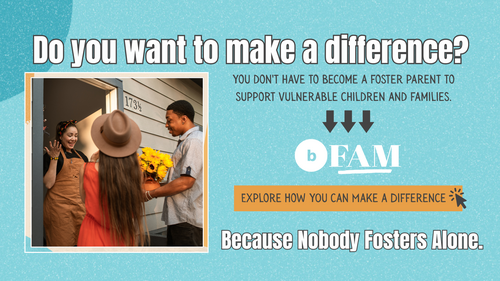
God does not call everyone to become a foster parent, but He does invite every believer to play a meaningful, redemptive role tailored to their own skills, passions, and life experiences. We can actively step into these stories by adopting a WRAP mentality:
Every child entering foster care has a story. Every biological parent fighting to reunify has a story. Every foster family opening their home has a story.
God does not call everyone to become a foster parent, but He does invite every believer to play a meaningful, redemptive role tailored to their own skills, passions, and life experiences. We can actively step into these stories by adopting a WRAP mentality:
- W — Words of Encouragement: Pray intentionally for foster families, biological parents, caseworkers, and children. Send a handwritten note, a text message, or simply remind someone they are not walking this journey alone.
- R — Respite: Step in to provide childcare, babysit for an evening, or offer a weekend of respite. Sometimes the greatest gift you can give an exhausted caregiver is a chance to rest.
- A — Acts of Kindness: Show up with tangible service. Bring a meal during a difficult week, mow a family's lawn, help with transportation, or run errands to take a load off their shoulders.
- P — Physical Provision: Meet the practical needs of families going through a transition. Provide diapers, formula, clothing, school supplies, beds, or gift cards that help ease the financial burden.
From Judgment to Compassion
Foster care was never designed to punish "bad people." At its best, it is a community safety net for families whose lives have unraveled and who need protection, support, and hope.
When we move from judgment to compassion, we begin to see families the way Christ sees them—not as problems to solve, but as people to love. Whether through Words of Encouragement, Respite, Acts of Kindness, or Physical Provision, every one of us can help write a different ending.
Because sometimes the greatest difference we can make isn't just rescuing a child—it's helping a family find hope before they ever need rescue.
When we move from judgment to compassion, we begin to see families the way Christ sees them—not as problems to solve, but as people to love. Whether through Words of Encouragement, Respite, Acts of Kindness, or Physical Provision, every one of us can help write a different ending.
Because sometimes the greatest difference we can make isn't just rescuing a child—it's helping a family find hope before they ever need rescue.
No Comments